
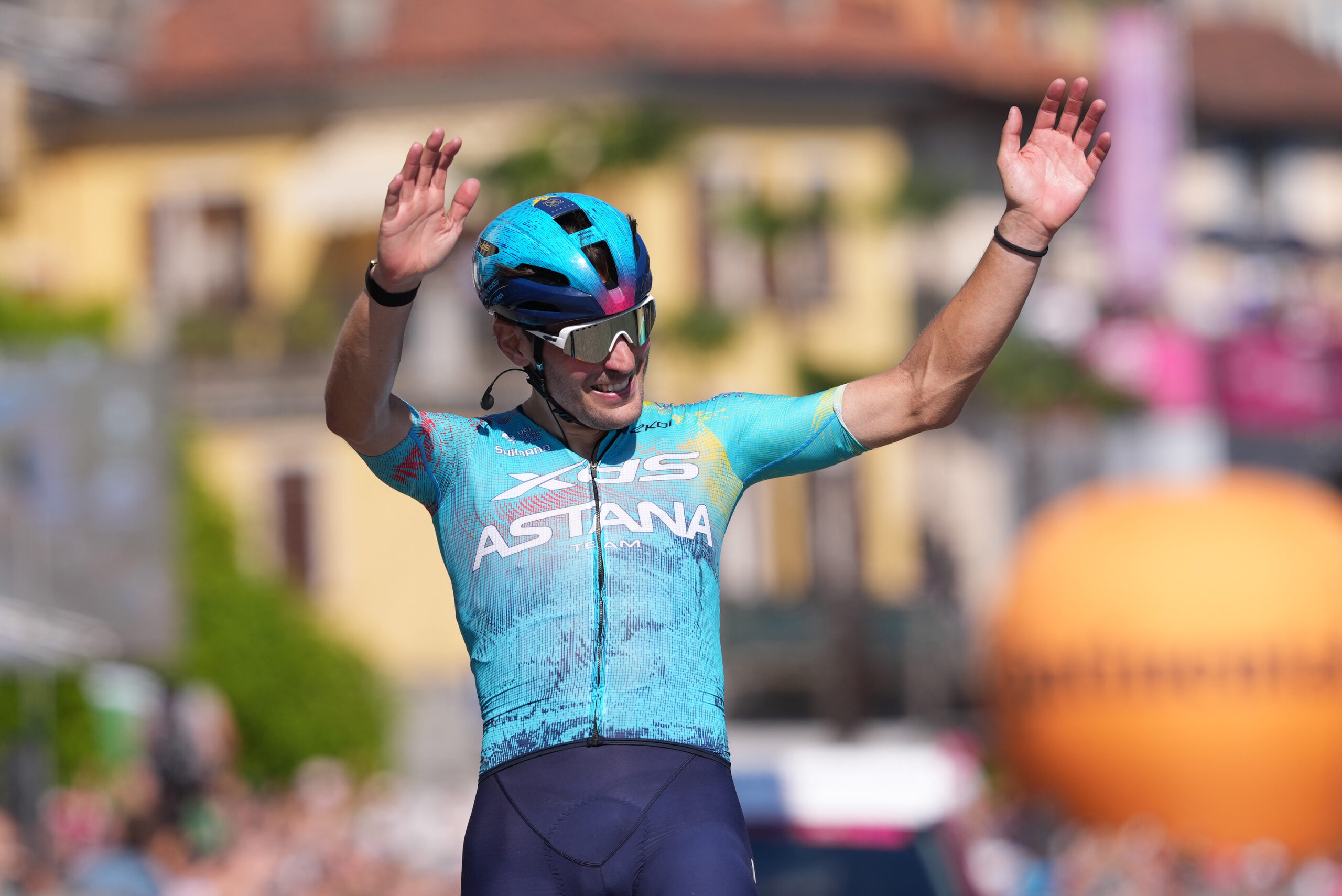
Alberto Bettiol solos to stage 13 victory in Verbania – Giro d’Italia
Giro d’Italia 2026
Stage 13
Alberto Bettiol swept to XDS-Astana’s third stage victory of the Giro d’Italia in Verbania, the Italian showing his strength on the final climb of stage 13 to blow the rest of the break away and solo to glory.
The 32-year-old Tuscan joined Thomas Silva on stage 2 and Davide Ballerini on stage 6 in triumphing for Astana this Giro, and the win is the second Giro stage of his career, following a similar ride from the break on a hilly stage to Stradella in 2021.
Bettiol, who lives just across the border in Switzerland, reeled in and caught Norwegian champion Andreas Leknessund (Uno-X Mobility) 13km from the line in the final kilometre of the 189km stage’s closing hill. He then showed his knowledge of the local roads to race to a 20-second advantage, which he defended all the way to the line.
Leknessund had no shot of making it back to Bettiol, but he did at least hang on to take second place, 26 seconds back. Jasper Stuyven (Lidl-Trek) led home the next group home – four riders rom the initial 15-man breakaway – to round out the podium at 44 seconds.
“Today in theory I won already before the start because I had all my family here and my second family because my girlfriend and all her family are from Verbania, so I consider Verbania my second home,” Bettiol said after the win.
“Having all of them – my brother, my father, my mum, and all the people who have always been around me – it was already a victory for me. But winning like this is something I will take with me forever.
“It doesn’t matter if it was two years since I won, but if I win like this, I’m happy to win every two years.
“I knew every single corner in the last 50km because I train here sometimes. I saw this climb a couple of months ago with a bike, with a motorbike, and I saw the film of the downhill several times. I knew the last kilometre was really really strong.
“I expected somebody from the climbers to attack stronger because this climb is really on the limit for me. But I knew the shape was good, and also I knew the fact that I knew the climb really helped me and that’s how I won.

“I’m so happy to have finally with this jersey. I’m happy because Vino really believed in me two years ago and he really wanted me in his team. Finally, I paid him back. I think, in general, that all of my teammates did a really amazing Giro so far, so I’m happy that I can also be part of this amazing Giro d’Italia for us.”
The largely flat stage was run off at an average of 48.456 kph, making it the 11th quickest in the history of the Giro d’Italia. That was the speed of Bettiol, though the peloton were somewhat slower, reaching the finish 13 minutes later.
Race leader Afonso Eulálio was second across the line from the peloton behind Bahrain Victorious teammate Damiano Caruso. He continue in the lead on to what is likely to be his final day in the maglia rosa.
The Portuguese rider heads into the mountainous test of stage 14 with a 33-second lead over Jonas Vingegaard (Visma-Lease a Bike), while Thymen Arensman (Netcompany Ineos) remains in third place, 2:03 down.
Stage 13 of the Giro d’Italia saw the peloton tackle another largely flat route, another day where a pair of hills threatened the sprinters.
The 189km northern run across Piedmont from Alessandria to Verbania was flat for the opening 160km, but the hills of Bieno (2.4km at 5.7%) and Ungiasca (4.7km at 7%), the latter lying 13km from the finish, were likely to play a major part in deciding the day’s winner.
The early kilometres of the stage saw attacks fly from a number of riders, including Mikkel Bjerg (UAE Team Emirates-XRG), Jonathan Milan (Lidl-Trek), and Chilean champion Vicente Rojas (Bardiani CSF-7 Saber).
It would take 8km for a move to go clear, with Rojas racing away along with Leknessund, former maglia azzurra Diego Pablo Sevilla (Polti-VisitMalta), Michael Valgren (EF Education-EasyPost), Johan Jacobs (Groupama-FDJ United), Larry Warbasse (Tudor), and Mark Donovan (Pinarello-Q36.5).

The break was far from decided however, as Bjerg, Filippo Ganna (Netcompany Ineos), and Stuyven joined in the attacks from behind.
After 20km of racing, and with the leaders just 20 seconds up the road, another group – Bjerg, Stuyven, Bettiol, Mirco Maestri (Polti-VisitMalta), and Francesco Busatto (Alpecin-Premier Tech) – jumped clear, eventually linking up with the front of the race 20km later.
By then, Rojas had dropped back to the peloton, leaving 11 riders in the lead with a gap of almost three minutes. Four more riders – Kench and his FDJ teammate Axel Huens plus Markus Hoelgaard (Uno-X Mobility) and Toon Aerts (Lotto-Intermarché) – came across to make it a break of 15 with 137km to run.
Behind them, Bahrain Victorious and Visma-Lease a Bike hit the front of the peloton, happy to let the move go as the gap grew over five minutes. By the time the break hit the 100km to go marker, their advantage had gone up to nine minutes, and the riders had covered the first two hours at an average speed touching 50kph.
The kilometres on the run towards the final climbs were a quiet affair. Little of note occurred on the flat roads of the Po Valley, and the break raced on to a lead approaching 11 minutes as they hit the final 40km.
The break stuck together over the top of Bieno, with Sevilla grabbing the three mountain points. They held a 11:40 gap at the base of Ungiasca, where Groupama-FDJ United hit the front to set the pace for Kench.
Jacobs peeled off first before Huens pushed the pace, dropping several riders from the group. Kench made his move 2.5km from the top – 15.8km from the line – on the steepest slopes of the hill.
The New Zealander found Bettiol, Valgren, and Leknessund on his wheel, and the Norwegian Champion was the next to make a move, attacking a kilometre further up. Meanwhile, Bettiol gave chase alone, gradually reeling in Leknessund as they neared the top.
Indeed, he made the catch before the summit of the climb, accelerating around the outside of one of the final bends, and blew past before the summit. Leknessund had no answer to Bettiol’s acceleration, and the Italian, flying down the descent, swiftly pulled out a 20-second advantage.
Bettiol raced a perfect descent and then had enough power left over for the flat final 6km. The combination meant he easily held off Leknessund’s chase to race into Verbania and claim the ninth victory of his career.

Further back, it was Stuyven who sprinted home to round off the podium, the Belgian holding off Valgren, Donovan, and the man who kicked off the attacks, Kench, to score third.
Saturday’s stage 14 of the Giro covers 133 kilometres and unfolds in and around the Aosta Valley. The riders tackle, in succession, the Col du Saint-Barthelemy and the climbs to Doues, Lin Noir and Verrogne before finishing uphill in Pila. The final ascent is 16.5 kilometres long and averages 7.1%.
After rolling out of Aosta, the riders head east through the valley and it doesn’t take long before they tackle the Saint-Barthélemy climb. The 15.8 kilometres ascent at 6.1% tops out at 1,619 metres.
The riders fly back down into the Aoste valley, only to follow it in the opposite direction. Once they return to the start town, the road climbs for 3.5 kilometres at 5.5% towards Roisan. The gradient eases for a moment before kicking up again on the ascent to Doues, which runs for 5.8 kilometres at an average of 6.2%.
The riders descend back towards Aosta – this time without actually entering the city – before the road turns uphill again on the Lin Noir: 7.4 kilometres at an average of 7.9%. There is no real descent afterwards. The road briefly dips before continuing uphill to the highest point of the day, Verrogne. That section is 5.6 kilometres long and averages 6.9%. As the Giro passes through the mountain village, just over 40 kilometres remain.
Again, the route drops down into the Aosta Valley, and after roughly 10 kilometres on the flat the final climb opens on the other side of the valley. The climb to Pila is 16.5 kilometres long and the average gradient sits at 7.1%.
Pila is a ski resort set on a high plateau, easily reached from Aosta via gondola. It offers stunning views, including a panorama of Mont Blanc.
Stage 13 result:
1. Alberto Bettiol (Ita) XDS Astana, in 3:51:33
2. Andreas Leknessund (Nor) Uno-X Mobility, +26s
3. Jasper Stuyven (Bel) Soudal Quick-Step, +44s
4. Michael Valgren (Den) EF Education-EasyPost
5. Mark Donovan (GBr) Pinarello Q36.5
6. Josh Kench (NZl) Groupama-FDJ United, all at same time
7. Mikkel Bjerg (Den) UAE Team Emirates-XRG, +1:33
8. Francesco Busatto (Ita) Alpecin-Premier Tech, +1:35
9. Markus Hoelgaard (Nor) Uno-X Mobility
10. Diego Pablo Sevilla (Esp) Polti VisitMalta, both at same time
General Classification:
1. Afonso Eulálio (Por) Bahrain Victorious, in 52:15:17
2. Jonas Vingegaard (Den) Visma-Lease a Bike, +33s
3. Thymen Arensman (Ned) Netcompany-Ineos, +2.03
4. Felix Gall (Aut) Decathlon CMA CGM, +2.30
5. Ben O’Connor (Aus) Jayco AlUla, +2.50
6. Jai Hindley (Aus) Red Bull-Bora-hansgrohe, +3.12
7. Michael Storer (Aus) Tudor Pro Cycling, +3.34
8. Derek Gee-West (Can) Lidl-Trek, +3.40
9. Giulio Pellizzari (Ita) Red Bull-Bora-hansgrohe, +3.42
10. Chris Harper (Aus) Pinarello Q36.5, +4.15
Discover more from Marking The Spot
Subscribe to get the latest posts sent to your email.

