
Michael Valgren takes stage 17 with attack from break – Giro d’Italia
Giro d’Italia 2026
Stage 17
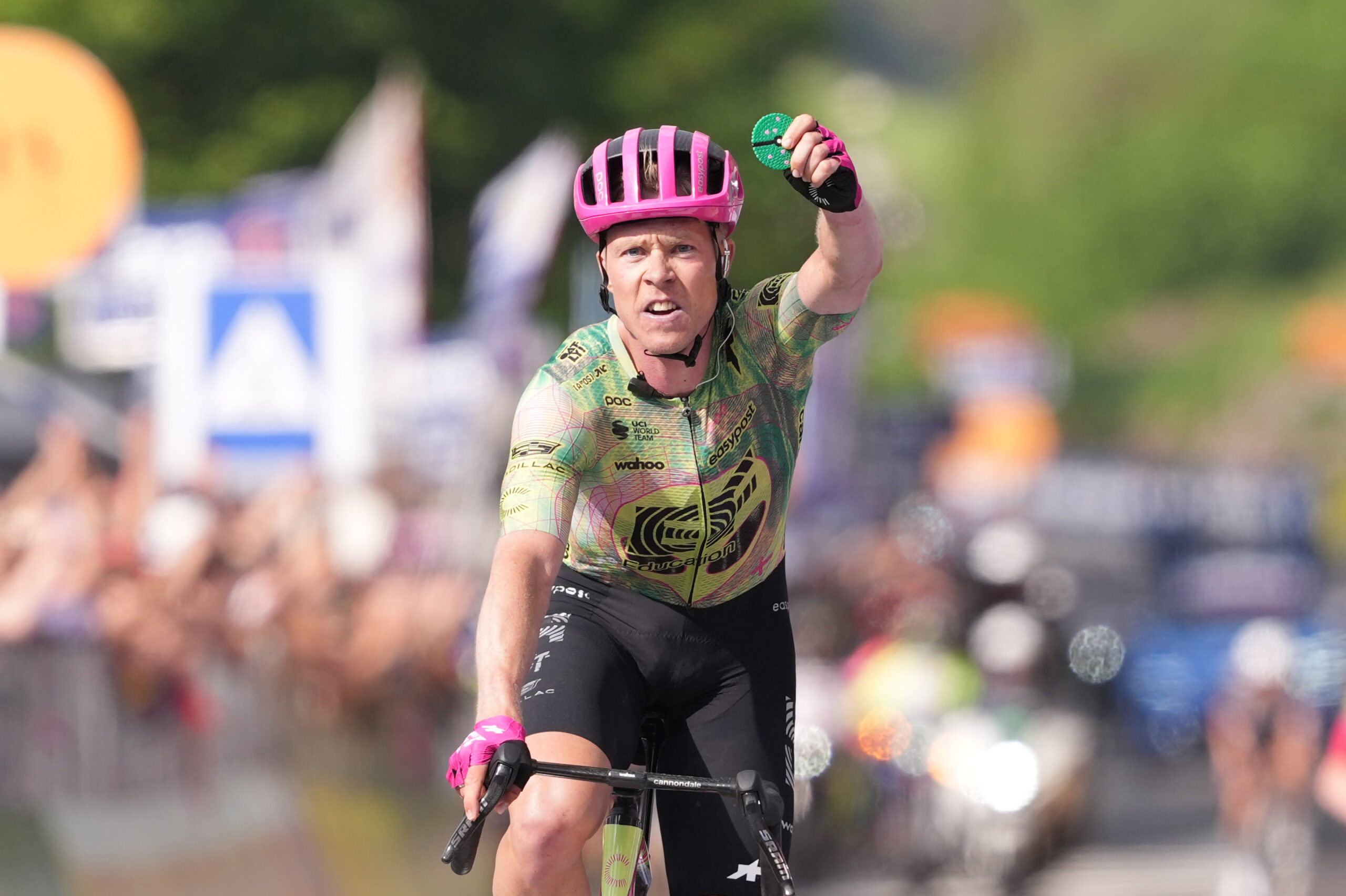
After 12 Grand Tours of trying and a career full of ups and downs, Michael Valgren (EF Education-EasyPost) finally took his maiden stage win at one of cycling’s prestigious three-week races, winning stage 17 of the Giro d’Italia from a breathless 202km breakaway battle.
Valgren emerged as the strongest from a 29-rider move that went in the opening half of racing from Cassano d’Adda to Andalo, but he was made to work hard for it by the likes of Einer Rubio (Movistar) and Damiano Caruso (Bahrain Victorious), who attacked several times in the final 45km.
Six riders ended up fighting out the stage win after the break split and came back together several times in the last 20km, but it was the late surge Valgren made 1100 metres from the line that broke the deadlock, earning him a special win ahead of Andreas Leknessund (Uno-X Mobility) and Caruso.
Coming onto the final climb to Andalo-Lever, Valgren was pushed to his limit by the stronger climber, Rubio, with whom he entered the finale in a duo, but as they were caught by first Igor Arrieta (UAE Team Emirates-XRG) and the rest of the chasers, it was the Dane who still had the tactical nous to make the perfectly-timed move.
As a former winner of massive races such as Amstel Gold and Omloop Het Nieuwsblad, Valgren is no stranger to the biggest successes, but after a near-career-ending crash in 2022, he only returned to winning ways for the first time since 2021 at Tirreno-Adriatico, earlier this season in March.
“It’s a funny thing, people think I’m fast [in a sprint], but I’m actually quite slow. My maximum peak power is ridiculously embarrassing to be honest, so this is my move, and when I have good legs I’m pretty good at it,” said Valgren, who explained his celebration over the line as being a lucky Pokemon charm from his son.
“It was a strange day, we were such a big group, and we never worked together, and I was getting kind of pissed, to be honest: ‘Why don’t we just try and race.’ It was super hard, I was really on my limit, and I didn’t have any food for a while because the cars were really behind us, so I was worried I was going to bonk. But luckily it was not 500 metres longer.
“I missed this [a Grand Tour stage] from my resumé. I think I deserve this, I think my career has been pretty good, but I needed this. Luckily, it came today and in Italy, apparently, I race really well here and it’s where I have most of my victories, so I’m really happy to be here.”

Fellow Dane Jonas Vingegaard (Visma-Lease a Bike) maintained his overall lead of the race in the peloton, which finished 5:15 after Valgren on what was a relatively calm day. The big mover on GC was Caruso, who leapfrogged Ben O’Connor (Jayco AlUla) into ninth thanks to his efforts in the break.
With stage victory chances running out thick and fast at the Giro d’Italia, stage 17 represented one of the final times for the would-be attackers to try their luck from the breakaway, with two brutal mountain finishes and a likely sprint in Rome to come on the final three days.
Several riders were very active right from the start, with average speeds in the opening hour heading out of Cassano d’Adda staying over 50kph, and no breakaway properly forming in the first 32km.
Two category-three climbs in the opening 90km of the 202km route were the best points to try and get away from the peloton, and it was before the first, the Passo dei Tre Termini, that an initial group of seven got away. They were soon joined by four others who chased on, but as they arrived at the second climb, Cocca di Lodrino, what was 11 in front was about to become 29.
Several teams were represented by more than one riders up front, but it was Movistar and UAE Team Emirates-XRG who would have been most pleased with the break’s composition: Rémi Cavagna (Groupama-FDJ United), Tobias Bayer (Alpecin-PremierTech), Damiano Caruso (Bahrain Victorious), Jardi van der Lee, Michael Valgren (EF Education-EasyPost), Giulio Ciccone (Lidl-Trek), Simone Gualdi (Lotto Intermarché), Enric Mas, Juanpe López, Einer Rubio, Lorenzo Milesi (Movistar), Jan Hirt (NSN), David de la Cruz, Mark Donovan (Pinarello Q36.5), Aleksandr Vlasov, Mick Van Dijke (Red Bull-BORA-hansgrohe), Gianmarco Garofoli, Fabio van den Bossche (Soudal Quick-Step), Gijs Leemreize, Frank Van den Broek (Picnic PostNL), Florian Stork (Tudor), Igor Arrieta, Jan Christen, Jhonatan Narváez (UAE Team Emirates-XRG), Manuele Tarozzi (Bardiani CSF 7 Saber), Mattia Bais, Alessandro Tonelli (Polti VisitMalta), Niklas Larsen (Unibet Rose Rockets) and Andreas Leknessund (Uno-X Mobility).
Race leader Vingegaard’s Visma team had shut up shop with this huge group getting up the road, and while they maintained a holding pattern, the 29 riders in front were able to build a lead of more than six minutes.
Cavagna kicked away on his own with 117km to go on Wednesday, and after 17km on his own, he was comfortably two minutes in front of the large group. He was gradually chased down, and it was UAE who did the lion’s share of the work to bring him back before the final 55km, allowing Narváez to target the intermediate sprint in Roncone, which he won ahead of Ciccone, moving him 10 points ahead of Paul Magnier and into the lead of the maglia ciclamino points classification.
Only one categorised climb remained on the route, but almost all of the final 50km dragged uphill to the line, prompting the likes of Caruso to try and attack away and make it a more manageable breakaway.

By the 28km to go mark, several riders had bridged to the original group of five in the lead, leaving 10 in front: Caruso, Valgren, López, Rubio, Van Dijke, Vlasov, Garofoli, Arrieta, Leknessund, and De La Cruz.
The closest chasing effort was led by Hirt, in a group also containing triple stage winner Narváez and blue jersey-wearer Ciccone.
Behind in the relatively calm peloton, Tudor and Jayco AlUla took over from Visma to try and control the breakaway, with Caruso threatening to leapfrog their GC leaders, Storer and O’Connor.
Wiley veteran Caruso kicked off on the approach to the final climb, Andalo-Lever (8.3km at 3.6%), but he was countered by Rubio, and behind in the second group – who were around 30 seconds down at the foot of the climb – Narváez and Ciccone were pushing to try and make it across.
Rubio remained the most active on the climb, and the action was breathless in front, with the Colombian cresting the top with Valgren in his wheel, Caruso, Vlasov, Arrieta, and Leknessund chasing 10 seconds back, but the Ciccone, Narváez group surely out of the fight for victory at 1:18.
The chasing quartet failed to work together in their chase, with one more uphill section and a flat run to the line still to come, while Valgren and Rubio did swap turns to try and ensure either of them claimed the stage win.
Arrieta went off in search of the win with 3.3km to go and 20 seconds to make up on the leading duo, dropping all three of the other chasers. In front of him, Rubio was attacking again, 2.7 km from the line, but he still couldn’t shake Valgren on the uphill road.
Contact was made by Arrieta with 2.3km to go, and as the road started to level up before the finale, this development allowed the other three chasers to also bridge the gap, making it six riders in front to fight out the stage win after all.
The battle became tactical, but it was Valgren who made the perfect move just before the final kilometre, launching a strong surge into the barriered section which no one could follow, allowing him time to celebrate his first Grand Tour stage win with three seconds to spare.
On Thursday’s stage 18 of the Giro, the riders cover 167 kilometres from Pinzolo to Pieve di Soligo. The undulating route is perfect for sprinters, if not for the brutally steep Muro di Ca’ del Poggio with 10 kilometres to go.
The start town, Fai della Paganella, sits at over 1,000 meters above sea level, but the riders will be flagged into action in Mezzolombardo, at 230 metres. Once the flag drops, they follow the Adige downstream to Trento, where the day’s longest climb begins: 4.9 kilometres at 6.2% to Civezzano.
Despite being the longest ascent, the Civezzano climb doesn’t offer any KOM points. While the route features plenty of undulations, there are only two categorised ascents. The first is a 3.2-kilometre climb at 3.9% to Fastro, which comes roughly at the halfway mark.
After that, the route continues to undulate without any significant climbs. The toughest uphill section is a 1.9-kilometre ramp at 6.2% in Combài, but the real focus of stage 18 is the second KOM climb of the day, which could very well prove decisive. It’s a genuine wall. The Muro di Ca’ del Poggio climbs for 1.1 kilometres at an average of 12.3%, with the summit located 9.3 kilometres from the finish in Pieve di Soligo.
Stage 17 result:
1. Michael Valgren (Den) EF Education-EasyPost, 4:41:33
2. Andreas Leknessund (Nor) Uno-X Mobility, +3s
3. Damiano Caruso (Ita) Bahrain Victorious, +6s
4. Aleksandr Vlasov (Rus) Red Bull-Bora-hansgrohe, a.s.t
5. Einer Rubio (Col) Movistar, a.s.t
6. Igor Arrieta (Esp) UAE Team Emirates-XRG, +14s
7. Gianmarco Gardoli (Ita) Soudal Quick-Step, +52s
8. David de la Cruz (Esp) Pinarello Q36.5, +1:08
9. Jhonatan Narváez (Ecu) UAE Team Emirates-XRG, +1:44
10. Mark Donavan (Gbr) Pinarello Q36.5, a.s.t
General Classification:
1. Jonas Vingegaard (Den) Visma-Lease a Bike, in 66:57:14
2. Felix Gall (Aut) Decathlon CMA CGM, +4:03
3. Thymen Arensman (Ned) Netcompany-Ineos, +4:27
4. Jai Hindley (Aus) Red Bull-Bora-hansgrohe, +5:00
5. Afonso Eulálio (Por) Bahrain Victorious, +5:40
6. Derek Gee-West (Can) Lidl-Trek, +7:09
7. Michael Storer (Aus) Tudor Pro Cycling, +7:14
8. Davide Piganzoli (Ita) Visma-Lease a Bike, +7:57
9. Damiano Caruso (Ita) Bahrain Victorious, +8:34
10. Ben O’Connor (Aus) Jayco AlUla, +9:20
Discover more from Marking The Spot
Subscribe to get the latest posts sent to your email.

