
For one generation, Messi’s World Cup farewell means more
The final whistle on Lionel Messi’s World Cup career did not feel like the end of a football match. It felt like the quiet closing of a door that had been open for as long as I can remember.
Not suddenly. Not dramatically. Just quietly, inevitably, and with the strange weight that only sport can carry when it has followed you through an entire life.
I have followed Messi since 2005 or 2006, back when he was still more rumour than certainty. Before the Ballon d’Ors, before the endless comparisons, before the world agreed on what he was becoming. I was a child then, watching this slight left-footed teenager do things that did not seem possible, and not fully understanding that I was watching the beginning of the greatest football career I would ever see.
The odd thing is that Messi did not just become part of my football life. He became part of the rhythm of growing up.
As I moved through school, through awkward teenage years, through university, through work, through the slow realisation that adulthood arrives whether you are ready for it or not, Messi was always there. Every season brought another chapter. Every tournament brought another hope. Every impossible goal felt like a reminder that football could still surprise you.
He made me fall in love with Barcelona. Through Barcelona, he made me fall deeper in love with football itself. Somewhere along the way, he also made me care about Argentina, a country on the other side of the world whose fortunes became emotionally significant because one player wore their shirt.
That is the strange power of a player like Messi. He does not just give you moments. He gives shape to the way you experience the game.
When I think back on the World Cups, I do not just remember the tournaments. I remember where I was in my own life. Germany in 2006, when he was the exciting young talent. South Africa in 2010, when expectation began to grow. Brazil in 2014, when the final felt like it might finally complete the story. Russia in 2018, when the weight of it all seemed almost too much. Qatar in 2022, when the story was finally completed in the only way that felt right.
And now, the final appearance. The final walk onto the grandest stage. The final time that the World Cup carried the possibility of one more Messi moment.
This tournament, fittingly, seemed to mirror Messi’s international career.

Argentina danced a tango throughout it, stepping in and out of rhythm, teetering on the brink before finding their feet once more. More than once they appeared finished, their hopes buried beneath the weight of expectation, only to rise again and keep the dream alive. It was untidy, emotional and utterly compelling – much like the journey that had brought Messi to this final World Cup in the first place.
There is an old saying that when a star is about to disappear, it shines with its greatest brilliance before fading from the night sky. Whether true or not, it felt strangely appropriate. Even at 39, Messi continued to produce moments that reminded everyone why generations had built their footballing lives around watching him.
Winning it in Qatar should have made this easier. In many ways, it did. There is comfort in knowing that the story reached its perfect ending. He did not leave unfinished business behind. He did not leave the one prize missing. Football gave him the ending it rarely gives anyone.
The image of Messi lifting the World Cup is likely to become one of the defining sporting photographs of the 21st century. It felt less like a victory and more like a resolution. The ending that the story had spent nearly two decades trying to reach.
In truth, everything since has been an epilogue.
The problem with epilogues is that they still have to end.
But endings can still hurt, even when they are perfect.
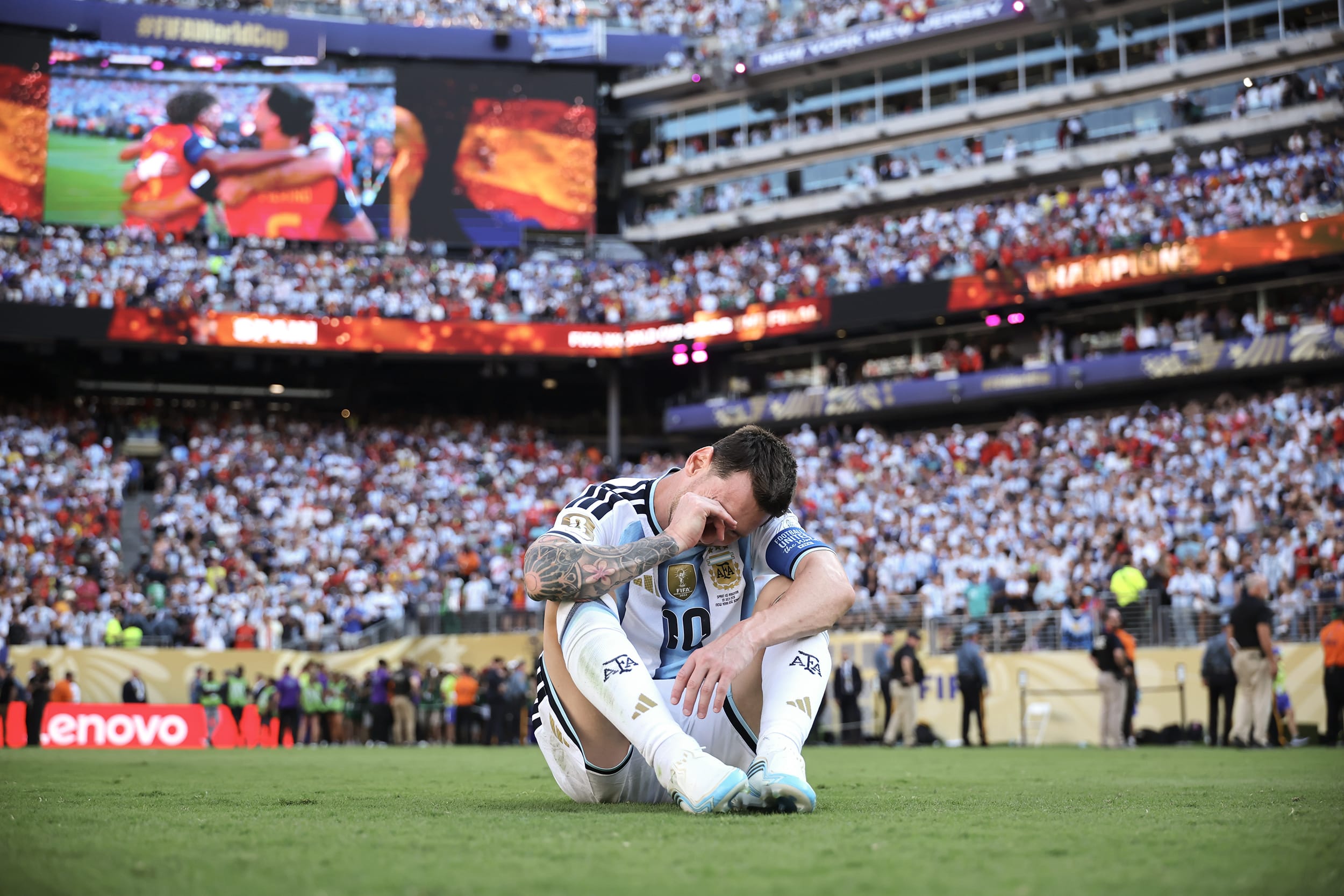
Messi did not immediately leave when the final whistle blew last night.
Instead, he remained seated on the turf at MetLife Stadium, taking in the scene around him, as though trying to hold onto it for just a few moments longer. The tears did not arrive straight away. They came later, after he had collected his runners-up medal. As he turned towards the sea of Argentine supporters and heard them singing his name one last time, the enormity of the moment finally seemed to reach him.
Watching his final World Cup game, I realised that the sadness was not really about the result or the performance. It was about what disappears with it.

I am 27 now, moving towards 28. Old enough to know that footballers retire, that eras end, that the players who defined your childhood cannot stay forever. But this felt different from every other retirement because Messi was the last one.
For my generation, Messi has been a constant. Not just a footballer, but a reference point. Someone whose career stretched across our formative years. Someone who was there when we first discovered the sport and somehow remained there long after childhood itself had disappeared.
That is why this feels unexpectedly emotional.
The last player who connected me directly to being a child in front of the television, waiting for something extraordinary to happen.
So much else from those years has already faded. The players I watched alongside him are gone. The rivalries have changed. The football world has moved on. Even the way we watch football has changed.
Messi was the final constant.
And when the final whistle blew it felt as though the last surviving thread to that version of myself had gone with it. Not in a dramatic way. Just quietly. Like real life usually does.
People who do not care about football will struggle to understand why a player retiring from a tournament can feel personal. But sport has a way of attaching itself to time. We remember goals, yes, but we also remember who we were when we watched them.
Messi has been there for almost all of my football memories. More than that, he has been there for almost all of my life.
There will be another World Cup. There will be new stars, new stories, new players for younger supporters to grow up with. Football will continue, because football always continues.

But for me, it will never feel quite the same.
Because Lionel Messi’s final World Cup was not simply the end of an extraordinary international career.
It was the closing chapter on the last remaining piece of my childhood.
Messi’s final World Cup appearance should be remembered as a celebration. He leaves as a world champion, a two time Copa América winner and, in the eyes of many, the greatest footballer who has ever lived.
Yet there is room for another emotion alongside gratitude.
A quiet sadness.
Not for Messi, who owes football nothing.
But for the realisation that I was not just saying goodbye to my hero. I was saying goodbye to the boy who had grown up watching him
Football will continue. Another World Cup will arrive. New stars will emerge and inspire the next generation in the same way Messi inspired mine.
But there will never be another first hero.
And there will never be another Lionel Messi.
Discover more from Marking The Spot
Subscribe to get the latest posts sent to your email.

