
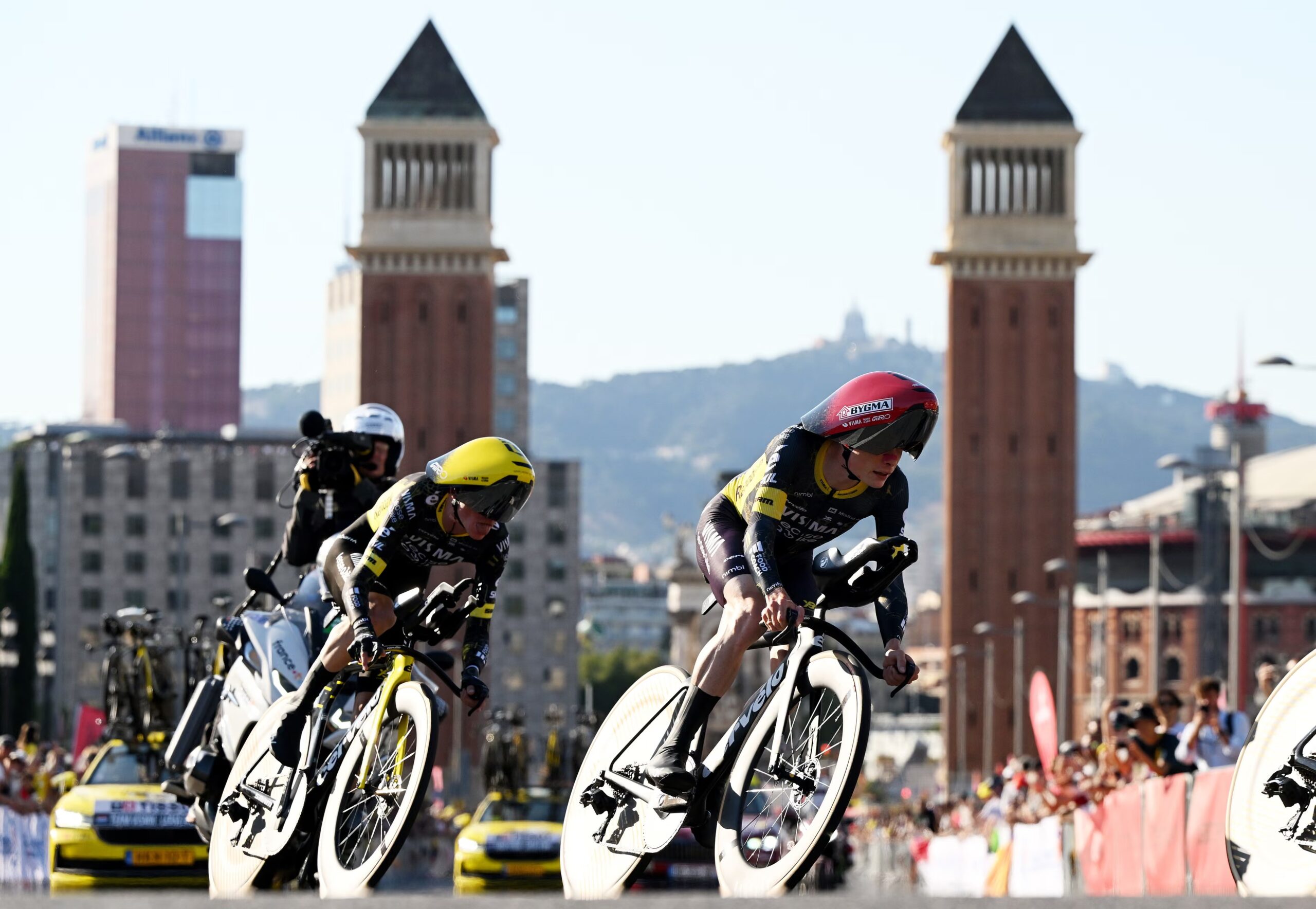
Jonas Vingegaard in yellow as Visma win stage 1 team time trial in Barcelona – Tour de France
Tour de France 2026
Stage 1
The 2026 Tour de France was billed to be an edition for the ages, and it got off to a thrilling start in the stage 1 team time trial, with Jonas Vingegaard (Visma-Lease a Bike) claiming the first maillot jaune.
Netcompany Ineos, led to the line by Filippo Ganna, were second, while defending champion and overwhelming race favourite Tadej Pogačar couldn’t make up for UAE Team Emirates-XRG’s slower start and finished third.
Visma-Lease a Bike may have been underdogs for the opening team time trial of the Tour de France after losing Wout van Aert from their roster due to illness, but Vingegaard stamped his authority on the race. With Matteo Jorgenson and Davide Piganzoli providing the final pulls, Vingegaard flew up the Côte de Montjuïc to unseat Netcompany Ineos from the hot seat by 7.33 seconds.
Vingegaard only had to wait for Pogačar’s UAE Team Emirates XRG squad to complete the 19.6km route in Barcelona, but the defending champion’s team were already down 13 seconds at the third check.
Together with Isaac del Toro, Pogačar turned on the afterburners with 600 metres to go, but finished 11.28 seconds down on Vingegaard and Visma-Lease a Bike.
Netcompany Ineos were forced to make a late change to their plan to launch Kévin Vauquelin when the Frenchman punctured with 7km to go, and instead sent Ganna in pursuit of the maillot jaune.
While Vingegaard was the one to take the yellow jersey, Ganna is second overall, 8 seconds down, with Pogačar third at 12 seconds.

“It’s the perfect start,” a visibly pleased Vingegaard said on Eurosport. “It’s still a long Tour, obviously, but it’s the perfect start. My teammates did an amazing job today. They were so strong, I didn’t have to do much, to be honest. They just drove me all the way to the finish, and to take the stage win for us, and to take the yellow jersey, also for me personally, after a few years without it, a few odd years, it’s nice for me to experience it again.”
Vingegaard hasn’t worn the maillot jaune since he won the race in 2023. Since then, he’s had several setbacks with crashes in the 2024 Itzulia Basque Country and Paris-Nice in 2025 influencing his Tour performance. With none of that in 2026, he appears to be back on form to challenge his long-time rival, Pogačar.
“I’m here to do the best possible GC, and to try to win, but it’s only stage 1,” Vingegaard said. “There’s a long way left – we have a small gap now, but of course, this is the perfect start for us.
“I’ve had a few tough years for obvious reasons, but, coming back to the Tour, just to be wearing the yellow jersey, is something special, something that I will enjoy.”
The Tour de France started with a team time trial for the first time since 1971, but with a few twists to the usual format. Each team’s stage time is no longer determined by the fourth rider, instead being measured by the first rider to cross the finish line. That meant teams worked to launch their overall leader up the final climb to the Olympic Stadium in Barcelona.
In addition, each rider had to fight for their own time as the general classification times were taken individually. The points jersey was up for grabs for the rider who completed the first time check the fastest, while the polka dot mountains jersey would go to whoever was quickest on the last segment from the foot of the climb to the finish.
While the TTT took place three hours later than a normal Tour de France stage, the temperatures were still high, and it showed on the intense 19.6-kilometre effort that started flat but ended with a pair of ascents of the Côte de Montjuïc.
The heat and brutal course caused the first teams to struggle. Caja Rural-Seguros RGA, the first team down the ramp, were down to two riders at the start of the final climb, with Alex Molenaar their first finisher in a time of 22:59.

They weren’t as disorganised as Picnic-PostNL, who were the quickest of the early starters at the first check, but then lost Warren Barguil and had to slow down to ensure the Frenchman could reach the finish inside the time limit. They came through 43 seconds slower than Caja Rural.
The fastest of the first block of teams was Groupama-FDJ United, who, despite a possible crash from Guillaume Martin and Clément Berthet, saw Romain Grégoire dash to the finish with the fastest time, 20 seconds quicker than Caja Rural.
Movistar were on a good ride through the second and third time checks, coming through a few seconds faster than Groupama, but Cian Uijtdebroeks cramped and lost contact with his team on the Côte de Montjuïc, and they had to wait for their GC leader. While Raul Garcia soloed to complete Movistar’s stage, Uijtdebroeks had to fight to the line with two teammates.
In another GC surprise, Ben O’Connor lost contact with Jayco-AlUla after the midpoint of the TTT, but the team went on to post the quickest time at check 3. Michael Matthews was their first finisher – nine seconds down on Groupama, but not bad for a guy who missed a large part of the season with two broken wrists.
Mathieu van der Poel was led out perfectly to the final climb after Alpecin-Premier Tech came through the third check quickest, taking the hot seat by 2.6 seconds.
Meanwhile, Netcompany Ineos were living up to their status as stage favourites, keeping the whole team together and setting the fastest time at check 1 and 2. But with 7km to go, Kévin Vauquelin appeared to have a slow leak in his rear tyre and had to let go. Then, Egan Bernal was dropped. The team were still 20 seconds up on Alpecin at the last check, and Tobias Foss led Ganna to the final kilometre, and the Italian champion powered up the climb to take the fastest time, a massive 31 seconds quicker than Alpecin.
Paul Seixas lived up to the expectations of the French fans, soloing to the finish just behind Alpecin-Premier Tech, but Lidl-Trek were really setting the course on fire, taking the fastest times at checks 2 and 3 despite Mattias Skjelmose puncturing. But Ayuso fell eight seconds short of Ganna’s time to take second.
Remco Evenepoel took massive pulls for Red Bull-Bora-Hansgrohe, with Florian Lipowitz struggling to hold the pace in the final kilometre as the time trial world champion powered away alone to the third-best time, 11 seconds down on Netcompany Ineos.

Visma-Lease a Bike kept four riders together, with Sepp Kuss powering over the penultimate climb before Matteo Jorgenson took over. Davide Piganzoli, who seemed to be holding on for dear life, buried himself with one last push before Vingegaard flew away to the quickest time by seven seconds.
Tomorrow’s stage 2 of the Tour de France will see the riders face 2,500 metres of climbing over a 168.5-kilometre route. Almost all of the climbing comes in the second half of the stage, with the toughest part centred on the finishing circuit on and around Montjuïc, Barcelona’s iconic city hill.
After starting in Tarragona, the riders head along 85 kilometres of flat roads on the Costa Dorada before turning inland towards Begues. To get there the road climbs for 6.1 kilometres at 6.5%. After Begues the road trends gently downhill for around 10 kilometres before another rise of 4.7 kilometres at 3.4% precedes the descent into the valley of the River Llobregat.
The valley is a major transport corridor that also carries the A-2 and B-23 motorways. The riders follow roads running parallel to these major arteries towards Barcelona, where they enter the finishing circuit with roughly 30 kilometres to go. The circuit twists and turns over Montjuïc, the hill overlooking the city.
The first of two climbs on the circuit leads up to Montjuïc Castle, or, in good French, the Côte du Château de Montjuïc. It’s a real leg-breaker: 1.6 kilometres at 9.3%, with a maximum gradient of 13%. From the top, the road drops for just over 1 kilometre before rising again for 700 metres at 7% on the Côte du Stade Olympique.
At the first passage over the Côte du Stade Olympique, there are 24.4 kilometres to go – two identical laps of 12.2 kilometres each.
Each lap begins with a descent, followed by a rolling section leading onto the two climbs: first the Côte du Château de Montjuïc, then the Côte du Stade Olympique. The finish line is placed on that last ascent.
The Montjuïc circuit does overlap with the traditional finale of the Volta a Catalunya, but this course largely stands on its own. The punchy climb up to Montjuïc Castle, for instance, plays no part in the Catalan race, and the finish line is in a different location altogether.
Stage 1 result:
1. Visma-Lease a Bike in 21:47
2. Netcompany Ineos, +8s
3. UAE Team Emirates-XRG, +12s
4. Lidl-Trek, 16s
5. Red Bull-Bora-Hansgrohe, +19s
6. Decathlon-CMA CGM, +39s
7. Alpecin-Premier-Tech, +39s
8. Groupama-FDJ United, +41s
9. Bahrian Victorious, +47s
10. Jayco-AlUla, +51
General Classification:
1. Jonas Vingegaard (Den) Visma-Lease a Bike in 21:47
2. Filippo Ganna (Ita) Netcompany-Ineos, +8s
3. Tadej Pogačar (Slo) UAE Team Emirates-XRG, +12s
4. Juan Ayuso (Esp) Lidl-Trek, +16s
5. Remco Evenepoel (Bel) Red Bull-Bora-Hansgrohe, +19s
6. Isaac del Toro (Mex) UAE Team Emirates-XRG, +26s
7. Davide Piganzoli (Ita) Visma-Lease a Bike, +28s
8. Florian Lipowitz (Ger) Red Bull-Bora-Hansgrohe, +35s
9. Tobias Foss (Nor) Netcompany-Ineos, +38s
10 Paul Seixas (Fra) Decathlon-CMA CGM, +39s
Discover more from Marking The Spot
Subscribe to get the latest posts sent to your email.

