
Narváez doubles up with stage 8 victory – Giro d’Italia
Giro d’Italia 2026
Stage 8
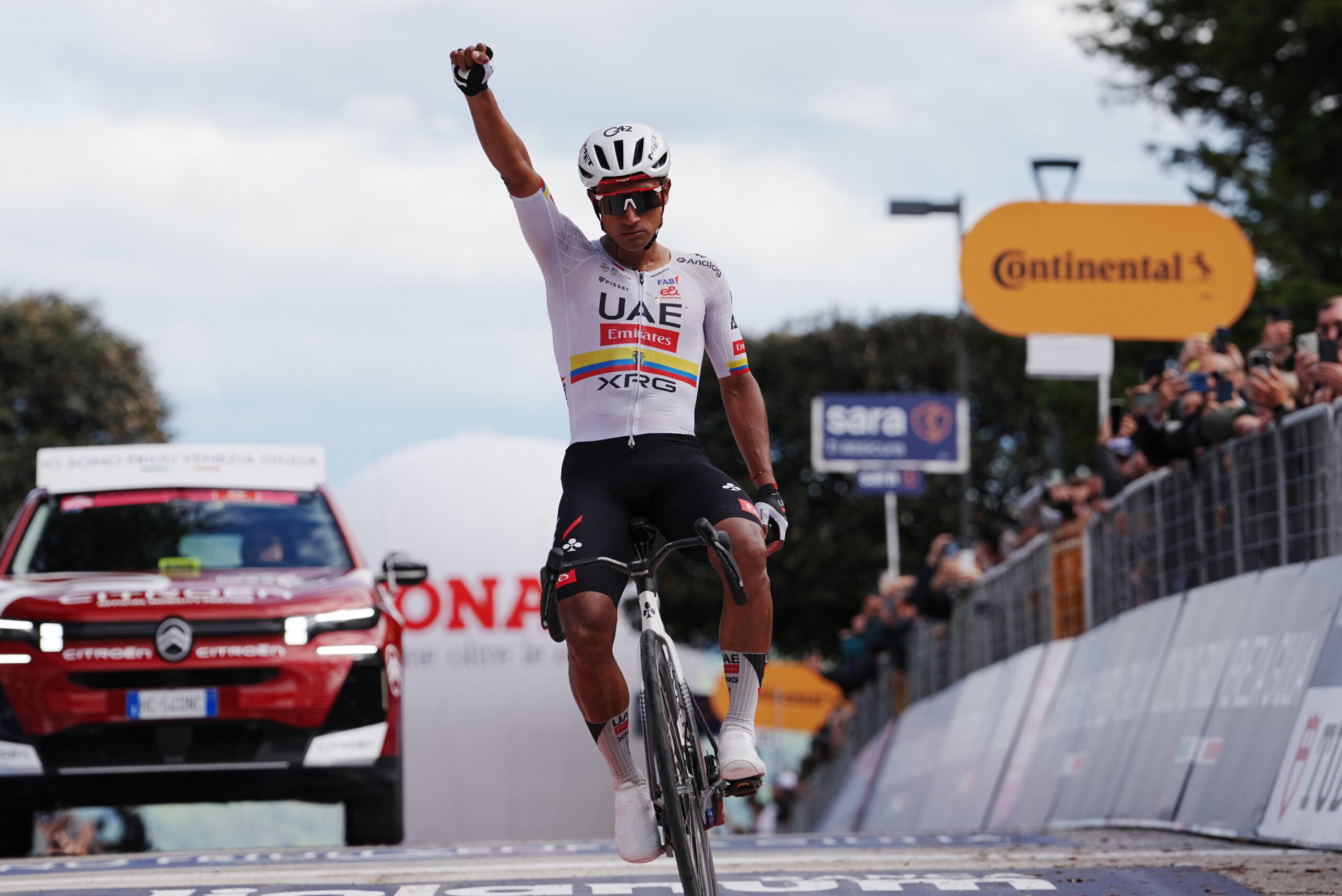
UAE Team Emirates-XRG’s Jhonatan Narváez claimed his second win of this year’s Giro d’Italia on stage 8, soloing to victory after attacking from the day’s three-rider breakaway, made up of his teammate Mikkel Bjerg and Uno-X Mobility’s Andreas Leknessund.
Bjerg did a lot of the work in the break, ultimately setting up for Narváez to attack on the penultimate climb, and quickly distance Leknessund.
The Norwegian fought valiantly to try to keep within touching distance of the Ecuadorian, and ground up the very steep final climb, but couldn’t quite close the gap and settled for second on the day.
Uno-X Mobility also took third, with Martin Tjøtta sprinting from the remainders of a large chasing group behind.
After a supremely long battle for the break and an incredibly fast start to the day, the trio finally got away in the final 80km, then followed by a large chasing group of over 30 riders. But despite the size of the chase, they found it impossible to actually catch the strong leaders, with Narváez going solo in the final 10km.
Despite a late dig, Afonso Eulálio (Bahrain Victorious) finished in the peloton just over two minutes down on the break and will continue to lead the race and wear the pink jersey for another day.
There was an opportunity for some GC action on the final climb, but Visma-Lease a Bike enforced a tough pace that shut down any hopes of an attack. There was a late sprint between the favourites for the line, but the gaps were only minor and likely won’t translate to any major time differences.
“It was a nice stage for me. The first part was really difficult, but I think we played it well with my teammate. I think he was the man of the day, Mikkel Bjerg, always you see him working for the team, even last year. He’s a guy who does a lot for the team. We made an agreement, I can say now [that Narváez would go for the win] but he was the man of the day for me,” Narváez said at the finish.

“I think in the end it was about the legs. The first part [of the stage] was full headwind, and riding the flat in the headwind for me was really hard, but I think we never gave up. 60km to go, we rode well, we rode smart, and then we had the opportunity to go for the stage.”
For UAE, this second stage win continues an impressive turn in fortunes after their team and GC hopes were decimated when they lost three riders in the first weekend of racing, and they are hoping for even more success.
“For sure it’s important for me, even coming from the injury in January, and we are just five guys but we play well, we have a good atmosphere in the team, so I think still [there can be] victories in the next week,” Narváez said.
It was a competitive battle to get in the break as the peloton rolled out of Chieti, with many riders and attempts in the first kilometres. The first pair to get away seriously was Filippo Ganna (Netcompany Ineos) and Alberto Bettiol (XDS Astana), but the fight continued. They stayed out front for nearly 50km, but only ever with a small lead, and they were brought back with 103km to go.
From there, the breakaway battle started once more, and with 85km to go there was still no actual break as dozens of riders kept trying. As a result of the lack of a break, the pace was incredibly high, over 50 kph in the first hour and a half.
With 75km to go, the fierce battle resulted in a major split in the peloton, which Jonas Vingegaard found himself on the wrong side of, forcing Visma-Lease a Bike into action to try and bring things back together. Meanwhile, UAE Team Emirates-XRG pair Narváez and Mikkel Bjerg were in the lead with Leknessund (Uno-X Mobility), just ahead of the first part of the peloton.
It didn’t take long for the peloton to come back together again, but the fight to get in the lead continued, with riders trying and failing to get across to Narváez, Bjerg and Leknessund, who were finally starting to build an actual lead. But it still wasn’t over, with a large group of another 20 riders attempting to bridge.
With no threatening riders on GC in the group chasing, the likes of Visma and Red Bull were trying to let the breakaway go, but not all teams were happy. On the first climb of the day, the Montefiore d’Aso, another swathe of riders attacked from the peloton to try and join the chase, and the high pace and continued attacks meant the gaps remained really small – though the three leaders held on.

Near the top of the climb, Giulio Ciccone (Lidl-Trek) dared a little acceleration, with Visma and Eulálio quickly shut down in a signal of intent. Instead, Lidl-Trek then sent Amanuel Ghebreigzabhier on the attack to bridge to the chasers, as Visma and Red Bull tried once more to blockade the peloton and put a stop to the attacks with over 30 riders up the road in various groups.
Narváez, Bjerg and Leknessung went over the top of the climb with around a minute over the chase group, and two minutes over the peloton, with things finally calming with 50km to go.
Despite the large number of riders in the chase, they struggled to get organised and make serious inroads on the leaders, who were working well with Bjerg doing a lot of riding. The chasers hovered around a minute behind the leaders, with the peloton three minutes down.
Just over the next climb, the Monterubbiano, Javier Romo (Movistar) attacked from the chase to try and join the leaders solo but with 25km to go he was still a minute behind. Bjerg won the Red Bull KM sprint, which the break didn’t really race for, and behind the chase group was starting to fragment.
As the finish approached, the leaders only built their advantage and it became clear that they would be contesting the win, despite the lengthy efforts from the chase.
With 10km to go, on the Capodarco climb, Bjerg and Narváez put in a one-two dig on Leknessund, with Narváez pulling clear of Leknessund and Bjerg tired after a long day of working for his teammate. The Ecuadorian soon then pulled clear of Leknessund too, going solo with just a climb and a half between him and a second stage win.
On the horribly steep final climb up to the finish line in Fermo, Narváez had to fight to hold off Leknessund who was not giving up, but the Norwegian could not do any more to close the gap and settled for second.
As Narváez soloed to the win, Visma-Lease a Bike mainly kept the pace high enough to shut down any attacks in the GC group, but in the final kilometre, it was Eulalio himself who put in an attack. Visma and Vingegaard shut that down, and from there it was only really the sprint to the line left.

Jai Hindley (Red Bull-Bora-Hansgrohe) opened up first to win that sprint for very minor placings, with Vingegaard right on his wheel, and the two did finish with a two-second gap on Egan Bernal (Netcompany Ineos) and the rest of the GC riders to make some very, very minor changes to the GC gaps.
At 184 kilometres, Sunday’s stage 9 of the Giro d’Italia travels from Cervia to Corno alle Scale. In the process, the riders take on 2,400 metres of climbing, most of which comes in the final 28 kilometres. The road rises at double-digit gradients in the last 3 kilometres.
The route is extremely flat until a 3.2 kilometres bump at 5.2% appears at kilometre 107. After that, the race settles back into its familiar rhythm. Nothing suggests that we’ll be finishing on a 1st-category climb later on.
From Silla onwards, with 28 kilometres remaining, the character of the route changes as the riders tackle the 3.5 kilometres climb at 7.2% to Gaggio Montano. The gradient then eases slightly, but the full ascent to Querciola runs to 11.3 kilometres at an average of 4.3%.
Upon passing through Querciola, the riders still have 16.6 kilometres ahead of them. First comes a short descent, and then the irregular final haul up the Corno alle Scale kicks in. The opening section climbs for 6 kilometres at 3.9%, although there are stretches nudging 9%, but it really comes down to the final 4.8 kilometres
The final act begins with 2.1 kilometres at 7.2%, after which it’s all hands on deck, as the road rises at an average of 11.5% over the next 2 kilometres. Just after the flamme rouge the gradient eases again.
Over its full length of 12.8 kilometres, the Corno alle Scale averages 5.9%. Including the approach via Querciola, the final 28.1 kilometres serve up a 4.1% gradient.
The Giro has finished on the Corno alle Scale once before. In 2004, Gilberto Simoni arrived at the line alone, followed 15 seconds later by the eventual winner of that edition, Damiano Cunego.
Stage 8 result:
1. Jhonathan Naváez (Ecu) UAE Team Emirates-XRG, in 3:27:26
2. Andreas Leknessund (Nor) Uno-X Mobility, a +32s
3. Martin Tjøtta (Nor) Uno-X Mobility, +42s
4. Thomas Silva (Uru) XDS Astana, +44s
5. Lorenzo Milesi (Ita) Movistar, at s.t.
6. Christian Scaroni (Ita) XDS Astana, +48s
7. Corbin Strong (NZL) NSN Cycling, +55s
8. Juan Pedro López (Esp) Movistar, at s.t.
9. Wout Poels (Ned) Unibet-Rose Rockets, +58s
10. Markel Beloki (Esp) EF Education-EasyPost, +1:00
General Classification:
1. Afonso Eulálio (Pro) Bahrain Victorious, in 34:28:42
2. Jonas Vingegaard (Den) Visma-Lease a Bike, +3:15
3. Felix Gall (Aut) Decathlon CMA CGM, +3:34
4. Christian Scaroni (Ita) XDS Astana, +4:18
5. Jai Hindley (Aus) Red Bull-Bora-hansgrohe, at 4:23
6. Giulio Pelizzari (Ita) Red Bull-Bora-hansgrohe, at 4:28
7. Ben O’Connor (Aus) Jayco AlUla, at 4:32
8. Mathys Rondel (Fra) Tudor Pro Cycling, at 4:56
9. Thymen Arensman (Ned) Netcompany-Ineos, at 5:07
10. Michael Storer (Aus) Tudor Pro Cycling, at 5:11
Discover more from Marking The Spot
Subscribe to get the latest posts sent to your email.

